Seven Albums, One Lineup: A Starter Guide to Gojira and the Designs That Follow Their Records
On 26 July 2024, a French metal band played the opening ceremony of the Paris Olympics. No hard rock or metal act had ever done that before. The band was Gojira, and the song they played, "Mea Culpa (Ah! Ça ira!)", went on to win the Grammy for Best Metal Performance at the 2025 ceremony.
If that night was your first taste of Gojira, there is a deep catalogue waiting behind it. This guide walks through where the band comes from, how their seven studio albums fit together, and which pieces of their artwork line up with which records, so you know where to start listening and what to look for if you want something to wear.
Who are Gojira?
Gojira formed in 1996 in Ondres, in the Landes, on the outskirts of Bayonne in south-west France. They started out under the name Godzilla and put out four demos under it: Victim (1996), Possessed (1997), Saturate (1999) and Wisdom Comes (2000). Around 2001 they had to change the name, and they chose Gojira, the romanised Japanese name for Godzilla.
The lineup is the part that stands out. Joe Duplantier on vocals and guitar, his brother Mario Duplantier on drums, Christian Andreu on guitar and Jean-Michel Labadie on bass. It has not changed since 2001. In a genre where bands reshuffle constantly, that is rare: every Gojira album you will ever hear was made by the same four people.
Their sound is heavy metal at its broadest, mainly progressive metal and technical death metal, with groove metal and post-metal running through it. The band is also known for lyrics that turn to environmental, spiritual and philosophical themes, and for environmental activism.
Where should you start with the albums?
Gojira have released seven studio albums. Here they are in order, with a note on where each one sits in the story:
- Terra Incognita (2001): the debut, released in March 2001 on the band's own label, Gabriel Editions.
- The Link (2003): the second studio album, two years after the debut.
- From Mars to Sirius (2005): released after the band signed to Listenable Records in December 2004, and in the US in 2006. It holds "Flying Whales" and "Backbone".
- The Way of All Flesh (2008): the fourth album, from their years with Prosthetic Records in North America.
- L'Enfant Sauvage (2012): the first album after they signed to Roadrunner Records in November 2011.
- Magma (2016): home to "Stranded". It was nominated for Best Rock Album at the 2017 Grammys, with "Silvera" nominated for Best Metal Performance.
- Fortitude (2021): home to "Amazonia", nominated for Best Metal Performance in 2022.
One easy way in is From Mars to Sirius, then a jump forward to Magma and Fortitude to hear how far the band travelled. If you like to start at the beginning, Terra Incognita and The Link show where it all came from.
There is a small Brooklyn-shaped footnote here too. Roadrunner Records, the label Gojira joined in 2011, is the same label that put out River Runs Red in 1993. Two very different heavy records, decades apart, on the same roster.
Which designs go with which record?
Two albums have their own designs, which makes them easy places to start.
From Mars to Sirius. The design carries an arched piece of artwork in orange and sand tones: a whale, a planet and stars, with the Gojira name and the album title. If "Flying Whales" is the song that got you, this is the one to look at. The Gojira From Mars to Sirius youth crewneck puts it on a sweatshirt sized for younger listeners, and the same artwork comes on a kids tee.
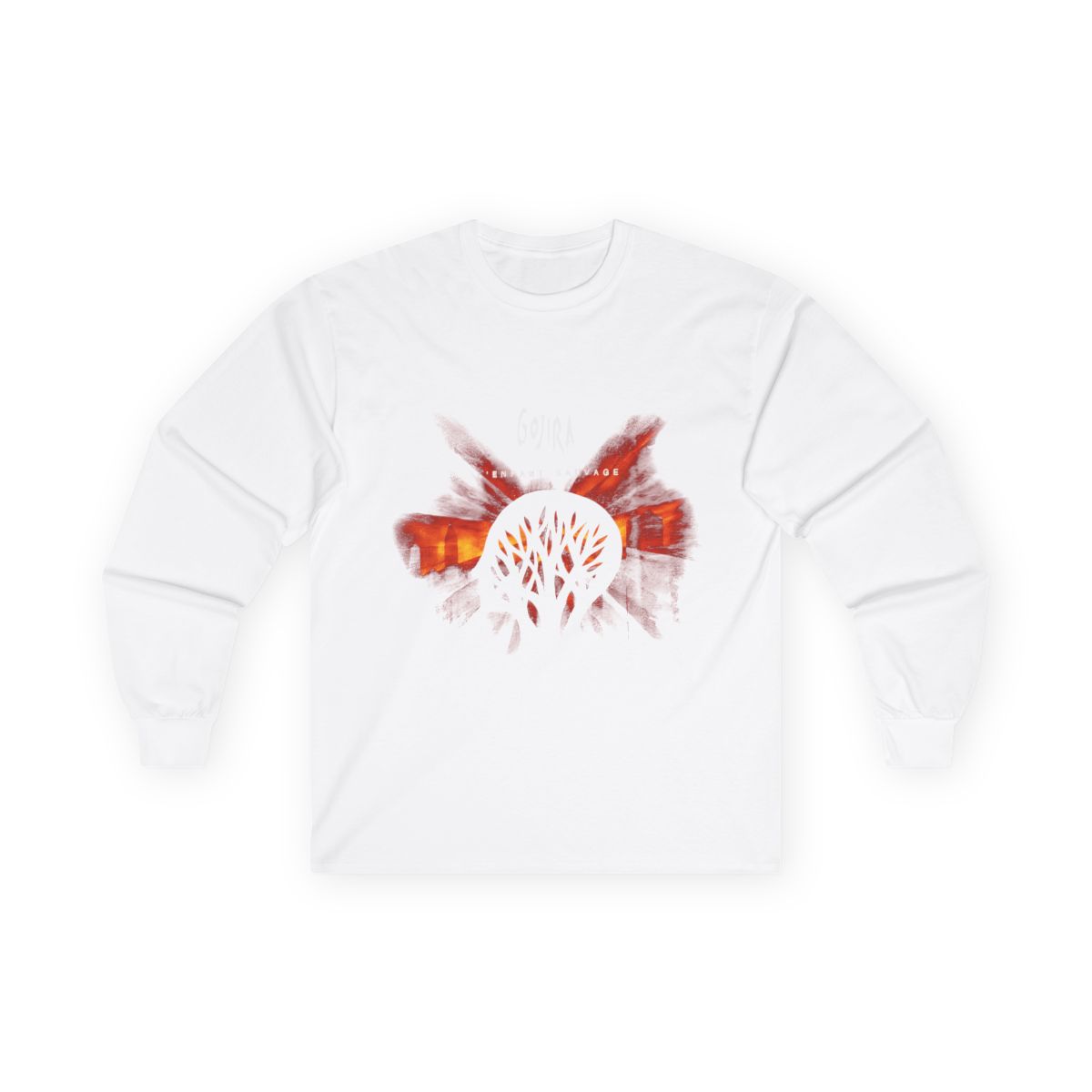
L'Enfant Sauvage. Red and orange brush strokes wrap around a white head filled with trees, with the words L'Enfant Sauvage. It is the louder, more colourful of the two album designs, and it comes on a unisex long sleeve tee, a youth hoodie and a kids tee.
What if you just want the name?
Not everyone wants an album on their chest. Gojira's range has three designs built around the name and natural imagery, each with a different mood:
- Stone Wordmark: the Gojira name in tall, uneven stone letters in a muted bone-khaki. Quiet, earthy and easy to wear with anything dark.
- Branch Logo: the logo in bright blue, its letters splitting into twigs and roots. The most colourful way to wear the name.
- Roots Rising: black-and-white artwork of roots fanning out into a pale, flame-like canopy. No colour at all, just contrast.
Those earthy, rooted images sit comfortably beside the band's reputation for writing about the natural world, and they suit someone who likes the sound but prefers a design that does not shout.
Who are these pieces for?
Much of Gojira's range comes in kids tees, youth crewnecks and youth hoodies, which makes it a good fit for a younger listener in the house. A few ideas:
- The kid who watched the Olympic opening ceremony and asked who that band was: From Mars to Sirius, for the whale and the stars.
- The teenager who has already worked through all seven albums: L'Enfant Sauvage on a youth hoodie, for the colour and the album that opened the Roadrunner years.
- The one who likes things understated: the Stone Wordmark or Roots Rising crewneck.
- The grown-up in the family: the unisex long sleeve tees, L'Enfant Sauvage among them, for layering in colder months.
If Life of Agony's heavier, rawer side is already in your rotation, Gojira is a natural next listen: another band that has stayed heavy and stayed together, and one with a story that runs from a small town in the Landes to an Olympic stage.
The short version
Start with From Mars to Sirius, then go forward to Magma and Fortitude. Keep in mind that the same four musicians made all of it. And when you want something that carries the music with you, pick the album design that matches the record you love, or one of the name designs if you would rather keep it simple.